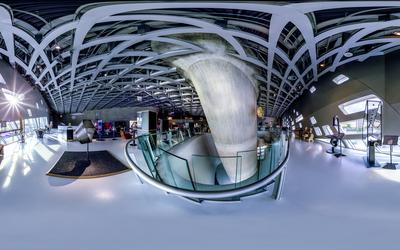
With "Bits & Bytes", phaeno is opening a new exhibition area in which the digital world can be experienced creatively and interactively. Topics such as artificial intelligence, coding, the Internet of Things and social networks meet playful experiments, art and genuine phaeno curiosity.
Discover the digital future!
In the "Bites & Bytes" exhibition, visitors can playfully immerse themselves in the fascinating topics of coding, artificial intelligence, the Internet of Things and social networks. Interactive hands-on stations explain how digital technologies work - and how they change our lives, our decisions and the way we live together.
"Bites & Bytes" invites visitors to critically question the opportunities and limits of digitalisation while experiencing how exciting and creative technology can be.
*Due to our renovation work, not all of the exhibits in the video are in the exhibition!
Masterpieces.
Five famous works of art have been digitised and combined with mechanical elements. You can move these and experience many surprising things: The mechanical hand pushes away a digitised person in the picture, a curtain is pulled up and the background of the picture disappears or an apple is blown up in the digital picture by a moving pump. This installation by Neil Mendoza playfully encourages people to think about the connection between the real and digital worlds. The artwork also invites you to engage with the images in a completely new way.
IoT marble run.
Playful IoT staging
IoT is a fascinating marble run that combines digital thinking and mechanical precision. Behind the black and white wall full of rhythmically clacking steel balls is more than just a kinetic installation: digital controls can be used to set points and steer the balls through spirals, magnetic tracks or loops. Anyone who wants to can even "hack into the system" using a QR code and play along live - or take countermeasures. This makes it possible to experience how networked systems work and the dynamics that arise when several players intervene simultaneously. This exhibit playfully demonstrates what the Internet of Things means - how it makes our everyday lives more convenient, but also how sensitive and susceptible to disruption digital networking can be.
Logic pinball.
This pinball machine works completely without random elements: Instead of hitting towers, the pinball machine has rocker arms that can assume exactly two positions. The pinball machine also has two launch directions for the ball. Visitors have to decide on each run whether the ball should pass through the field of rocker arms from the left or the right.
It is not easy to create a specific pattern with the toggle levers, as the positions of the toggle levers are logically dependent on each other.
Man or woman?
At this station, visitors can have their age and gender determined by a computer programme. They can also use wigs and glasses to influence the results. The programme is based on an artificial neural network that has been trained with a large number of images of faces. In addition to the age and gender determined, the visitor is also shown which areas of the face are important for the respective decision. This method, called "Layerwise Relevance Propagation", is used to test the learning success of an artificial neural network.
The Fraunhofer HHI's LRP demonstration is a particular highlight of this exhibition. It shows how artificial intelligence "learns" and makes decisions. Visitors can understand how neural networks recognise faces, handwriting or numbers and which image areas are decisive for these decisions.
With the help of so-called "heat maps", it becomes clear which features an AI actually uses - and that these are sometimes very different from what we assume.