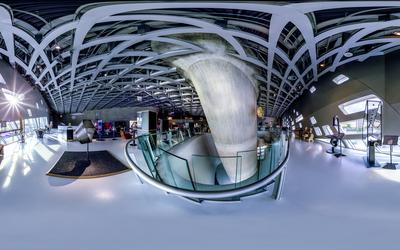
Science comes to life at phaeno - especially when it comes to the fascinating interplay of light and colour. From dancing shadows to soap bubble films, you can experience how colours appear, disappear or overlap. Discover what happens when light meets lenses, filters or soap suds - and find out why science is not only smart, but also really fun!
Light & vision
In the LIGHT & VISION area, extraordinary interactive stations and works of art invite visitors to explore various light phenomena: The spectrum ranges from physically demanding to playful and astonishing exhibits. The aspects of "seeing", "properties of light", "shadows" and "quantum phenomena" can be experienced through unique physical and perception-orientated phenomena.
From dancing shadows to soap bubble films, guests can experience how colours appear, disappear or overlap. They discover what happens when light meets lenses, filters or soap suds.
Light installations.
Some large installations are the focus of the area: in the Pavilion of Lights you can experiment with monochrome light and a giant bubble film invites you to play. If you like, you can freeze your shadow or discover the mysteries of quantum physics at the "Quantum Jungle" artwork.
Other works of art round off the spectrum of the exhibition and fascinate visitors with the aesthetic phenomena of light with plasma and LEDs. One well-known phenomenon here is the plasma ball, which magically attracts lightning with your hand.
The video shows a plasma ball that can simulate lightning.
Science - truly magical.
Blue flashes follow the slow movements of the hand on the glass surface of the plasma ball. But what exactly does the plasma ball invented by Nikola Tesla in 1892 show us?
Here's what's behind it: If an electric field between two poles becomes so strong that the gas molecules in between are separated into their positive ions and negative electrons, luminous flashes are created. In the plasma sphere, one of the two poles is located inside the sphere. The other pole and lightning rod is us! Don't worry - the currents are so low that it is completely safe to touch them.
The sphere is filled with a gas mixture that is also responsible for the colours of the lightning: Neon. With a proportion of 80 - 90 %, neon produces the bright glow, xenon (approx. 10 %) causes the blue colour. Oxygen and nitrogen in very small quantities influence the shapes of the flashes. By placing your hand on it, you change the electric field.
Giant soap film wall.
Colours as if from another world.
Pull the string and let a huge film of soap rise up. What you see is impressive: extraordinary colour patterns emerge and change in dazzling colours right before your eyes. Why?
The light is reflected from both the front and the back of the thin film. These light waves overlap - depending on the thickness of the film, certain light is cancelled out or intensified. This is how the fascinating play of colours is created.
Science extra: There is real physics behind the fun - from surface tension and light interference to currents in the film. Anyone who gets involved will discover how entertaining learning can be.
Light shows.
Experimenting with light.
How can light be directed, refracted or split? In our interactive exhibit "Light Games", you can discover the fascinating world of light rays in a playful way.
You can try out for yourself how light rays can be deflected using mirrors and coloured filters. Can you manage to guide a beam of light completely around the centre block? It becomes clear: mirrors reflect and filters only let certain colours through.
What you learn here:
How light rays are influenced by different optical elements
What role refraction and reflection play in everyday life
Discover our exhibits together.
Recollections.
Your movement as a work of art
A highlight - not just for Instagram! Stand in front of the large projection screen and move. Your silhouette becomes colourful, distorted, multiplied - past and present dance together in rainbow colours.
A camera records you, software transforms your movements into art - with colour gradients like stroboscopic images. Every movement remains visible as a colour track, new shapes are constantly being created.
Extra tip: Many people use Recollections for spectacular Insta photos. What about you? Become part of a living work of art! Share your pictures and memories with us on Instragram.
ED TANNENBAUM. The New York artist has acquired independent knowledge of electronics and electrical design through the construction of his objects. Here you can find more Art objects at phaeno!
Colourful shadows.
Dance with your play of colours.
Three light sources - red, green and blue (RGB) - illuminate a white screen. If you stand in front of it, you cast not one, but several colourful shadows!
Each colour casts its own shadow. Where the shadows overlap, new colours are created. Move around, hold a spotlight or try out how you can create yellow or even black shadows.
Did you know? Television images are created in a similar way - just pixel by pixel.(RGB model)
Spectral Landscape.
A highlight at phaeno is the Spectral Landscape art installation by American artist Pete Stephens. Sunlight is bent at the windows of the south façade with the help of special foils, transforming parts of the exhibition into an impressive sea of colour.