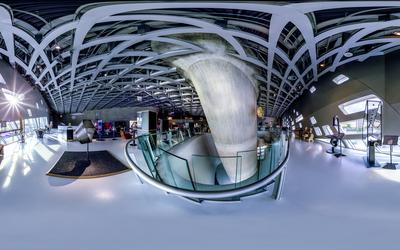
With experimental stations for school corridors and classrooms, phaeno actively contributes to the promotion of STEM subjects.
The Miniphenomenta conquers primary schools throughout Lower Saxony
Rolling balls and swinging pendulums provide variety during the break
The major phaeno project for primary schools throughout Lower Saxony - the Miniphenomenta - reached its climax this week at the Wohltbergschule in Wolfsburg. The project, which is sponsored by the savings banks in Lower Saxony, enables primary school children to work with teachers and parents to make their own science exhibits and set them up in the classrooms.
"The Miniphenomenta encourages all children to take an interest in science and also promotes language learning thanks to its highly stimulating nature. We will integrate experimentation and a visit to phaeno even more into everyday school life through the Miniphenomenta," explained Ute Gezer, Headmistress of the Wohltberg School.
In just a few hours, the unbelievable became reality in the school playground: teams of pupils and adults built exciting experiments themselves in a single afternoon under expert guidance. The resulting exhibits can now be used by the school community - this is experimentation and trial and error for everyone. The basic idea of the project is to get pupils interested in and excited about science.
"I can do it myself"
"It's cool that I can take part here. I like trying out everything. I think the rolling balls are great," said a delighted pupil, Emely, who helped set up the exhibits together with other pupils. With the help of the adults, the pupils drilled holes in wooden spheres, drew circles with compasses and eagerly glued wooden parts together.
"phaeno is unique in the region and the project makes it even more present in schools. Seeing on site how well the children know physics and how deeply they engage with the subject through the Miniphenomenta is very impressive," explains Silke Comberg, Director of the Wolfsburg region for Sparkasse Celle-Gifhorn-Wolfsburg.
So far, 380 pupils, 305 parents and 79 teachers from all over Lower Saxony have taken part. The primary schools applied independently or were recommended by the savings banks. "The huge response to the project shows," says Luise Dorff from the phaeno school team, "that once you have experienced this principle of independent learning, you want more of it."
The Miniphenomenta comprises a total of three components: First, the teachers come to phaeno and learn how to build the first exhibits. Then they go to school to build further exhibits in teams with teachers, parents and pupils. There are also online training sessions in which the teachers receive suggestions on how to use these exhibits appropriately in the classroom.
At the end of the project, the participating schools have a collection of 15 to 20 exhibits that are used repeatedly throughout the year.
Benefit for the whole region
From Emden to Georgsmarienhütte and, of course, Wolfsburg, there are now exhibits in the primary schools that create a link to the interactive and research-based learning at the phaeno Science Centre.
"Doing things yourself, gaining your own insights and giving free rein to your curiosity are the focus of the Miniphenomenta and the Science Centre phaeno. We are delighted that the project is having an impact on the whole region," says Michel Junge, Managing Director of phaeno.
The project is sponsored by the savings banks in Lower Saxony with funds from the Sparen+Gewinnen lottery.