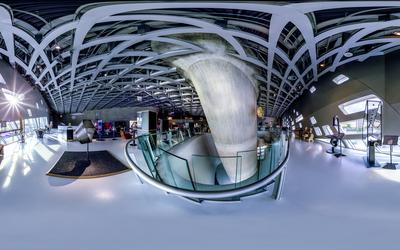
In the new "Under Current" area, you can explore key physical principles of electricity and magnetism in an exciting, intuitive way: high voltage, induction, static forces and magnetic fields become visible, audible and tangible. Interactive stations immerse you in the fundamentals that power our modern world — and give you an insight into key topics of our future.
Discover now.
For children, teenagers and adults: Perfect for anyone who enjoys experimenting and wants to understand physical phenomena.
For school classes and teachers: This area is particularly suitable for school classes and learning projects – physics and electrical engineering can be taught here in a practical and lively way.
For families with children: Certain exhibits are particularly exciting for younger children – such as the artistic area with light and sound or the enchanting "dancing magnetic hedgehogs".
For EVERYONE interested in science and technology! Come and explore the fascinating "Under Current" area! See for yourself how exciting physics can be.
Oasis 2 - When do which neon tubes light up?
Press, hold, marvel: as soon as the start button is pressed, the spark jumps across. Which neon tubes light up is decided anew each time.
Artist Cork Marcheschi uses so-called Jacob's ladders: pairs of metal rods connected in parallel and supplied with a high-voltage source of around 15,000 volts. When a spark jumps across a Jacob's ladder, electricity can flow – and one or more neon tubes begin to light up. At the same time, the other pairs of rods remain without sparking for a short time.
When electricity flows through the metal rods, a magnetic field is created. The rods repel each other slightly, begin to oscillate and start to swing. In the process, the sparks repeatedly break off and reignite elsewhere. This results in random, rhythmic switching on and off of the neon tubes.
An exhibit that makes high voltage visible – and shows how physical forces can be transformed into a lively interplay of light, movement and chance.
Belt generator | Van de Graaff generator.
At the tape generator, you yourself become part of a gigantic electrical circuit. As soon as you touch the metal ball, billions of negative charges spread across your body. The problem: charges of the same name repel each other extremely strongly. Since each of your hairs is now charged in the same way, they try to achieve the maximum distance between each other. They literally flee from each other – the only way out is straight up!
As spectacular as it looks, it is completely safe. Although the voltage is very high, the current is extremely low. So the worst that can happen is a big grin or a new favourite hairstyle – but there is no risk.
Are you ready to get electrified?
Dancing Magnetic Igel – David Durlach.
Fine iron particles form small, hedgehog-like structures and reveal how magnetic fields work. They align themselves along the magnetic field lines – and trace them all by themselves.
The interaction of permanent magnets and computer-controlled electromagnets constantly creates new fields. At the touch of a button, the magnetic hedgehogs begin to move: sometimes calmly and fluidly, sometimes dynamically – even in perfect techno beat.
With the interactive pad, you become the choreographer: the movement of your own hand controls the electromagnets under the 4×4 metal fields. A programme regulates the current strengths of the individual magnets – and makes the iron particles dance.
An exhibit that makes physics audible, visible and surprisingly rhythmic – magnetic fields can not only organise, but also groove.
Electric fleas – when charges learn to jump.
Rub, look, marvel: when you rub the dome or glass plate with the fur, something surprising happens. The small polystyrene balls or chips inside begin to jump around – almost like tiny fleas. They are attracted to the surface, bounce off or veer to the side.
The reason for this is electrostatic charge. Rubbing causes the dome to become electrically charged. Some beads are attracted, while others – if they already have the same charge – are repelled. When you touch the dome with your hand, the charge flows away through your body. The beads lose their "drive" and fall down.
What we see here happens all the time around us – but usually goes unnoticed. All materials consist of positive and negative charges. Normally, they balance each other out. Only when charges are unevenly distributed does electrical tension arise. When rubbed, electrons migrate from one material to another. Some materials are particularly good at holding onto electrons, while others release them more easily.
Because electrical charge can accumulate on insulating materials, the effects remain clearly visible here. And sometimes they are even spectacular: from jumping beads to sparks and flashes.
An exhibit that shows how friction turns into motion – and how lively electricity can be.
Magnetic sculptures – building with invisible force.
Here, inconspicuous discs are transformed into a true work of art – and even the youngest children can enjoy it! The metal discs are made of iron and are actually non-magnetic. However, when a magnet is brought close to them, something exciting happens: the discs become temporarily magnetic and attract each other.
This allows simple discs to be used to build small towers, figures or imaginative sculptures – all with the power of magnetism alone. Children and adults alike can playfully discover how invisible forces create shapes and how simple elements can be used to create something very special.
An exhibit that shows that magnetism is not just physics – it's also a lot of fun!
For schools and teaching
Hands-on experiments: Physics instead of traditional teaching — electricity, voltage and magnetism come to life.
Topics for curricula: Electromagnetism, energy, technology, sustainability — ideal for teaching physics, natural sciences and technology.
Teaching topics of the future: energy, technology, science — with a real-life experience.
Learning-friendly & safe: Many exhibits are self-explanatory, safe and also suitable for groups and school classes.
We also offer various discovery tours on the topic.
An extensive workshop programme complements the topic of electricity and magnetism.