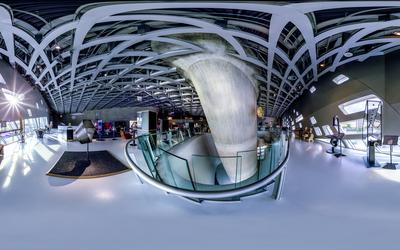
It’s Bubblemania time again – just in time for the autumn half-term holidays, we’re kicking off our soap bubble festival for the whole family. Discover all there is to these iridescent wonders.
The fascination of maths - where logic and magic meet.
Experience maths in a new way - playful, interactive, surprising!
"In this house, everyone can do what I want." With this classic saying, Oskar von Miller, the founder and influential designer of the "German Museum of Masterpieces of Science and Technology" in Munich, summarised the "education-oriented hands-on principle" almost 100 years ago.
This quote illustrates phaeno's philosophy of presenting maths not just as abstract theory, but as a lively, interactive experience. Our new exhibits in the "Maths Magic" area invite visitors to discover maths in a playful way and make their own discoveries.
Tinkering like real researchers
Children and adults can playfully test their logic and stamina with "knot puzzles": eight different knot puzzles of varying degrees of difficulty involve solving loops, moving rings from one loop to another or transferring complex structures into one another.
In the process, our explorers train their spatial imagination, strategic thinking and patience. At the same time, they gain an exciting insight into mathematical topology, a field that is also used in polymer physics and biochemistry.
A wide variety of patterns with small tiles or geometric figures can be laid at the "mosaic table". It is noticeable that many patterns are created simply and without gaps. This is due to the special shape of the tiles - they all have angles of 30°, 60° and 120°.
These and other exhibits show that tricky tasks are not only fun, but also encourage creative thinking and problem-solving skills in a playful way. Will you join in?
Hyperbolic slit.
How is the straight red rod supposed to fit through the recess in this curved shape? Trying it out reveals the secret.
The recess in the plate describes a hyperbola, a special kind of curve. If you pass the rod through it and turn it, it describes a hyperboloid surface - an elegant geometric shape that looks as if it is curved, but is actually made up entirely of straight lines.
This phenomenon shows that curved surfaces do not always have to be "curved": they can be composed entirely of straight lines. This is referred to as a regular straight enveloping surface, which is equally exciting for engineers, architects and mathematicians in geometry.
Amazement guaranteed: The red rod glides effortlessly through it - creating a perfect, seemingly curved shape in the air.
An amazing example of how our eyes sometimes deceive us - and that geometry is full of surprising magic!
Schneidering - When 3D meets 2D.
In "Schneidering", children and young people discover in a playful way how three-dimensional bodies are broken down into surprising two-dimensional cut surfaces. A fanned-out laser penetrates Plexiglas bodies such as cubes or tetrahedrons and makes the edges of the cut surfaces visible - a fascinating insight into the geometric structure of the objects.
You will learn how to think spatially and understand the mathematical relationships between 3D shapes and their 2D sections. With six laser sources, optimised object placement and new, more robust shapes, the exhibit is particularly vivid and safe. In this way, "Schneidering" impressively demonstrates how maths and optics are linked and how exciting it is to experiment with shapes.
Rotaring figure - From 2D to 3D.
Experience the transition from flat 2D shapes to vivid 3D bodies! At this station, you can rotate two-dimensional cards with imprinted motifs. The rotation creates exciting three-dimensional bodies from the flat shapes - a fascinating experiment in geometry!
There are four different shapes that you can try out:
Half of a light bulb
Half of a wine glass
Two different angles
What exactly is happening here? You will experience solids of revolution that are created when a 2D surface is rotated around an axis. You will be familiarised with the mathematical concepts of rotation, volume calculation and symmetry. You will see live how angles and axes affect the shape.
The experiment brings maths and art together and shows how abstract mathematical ideas become visible and tangible. It is an exciting experience for anyone who enjoys science and maths!
Quick diversions.
In this exciting experiment, you can organise a race with balls on two tracks - one of which is longer than the other. Surprisingly, the track with the longer path wins!
Why is that? The longer track is a so-called brachistochrone, the fastest way to get from one point to another. It's not just about the length of the track, but also about the course and inclination of the track. Both balls start at the same speed, but reach their destination at different times - the ball on the "diversions" is faster!
There are these stations with one, two or three trajectories in our maths area, which illustrate different aspects of brachistochrone and show you how speed and movement are connected in surprising ways.
A fascinating example of optimisation and mathematics in physics that clearly explains the laws of motion!