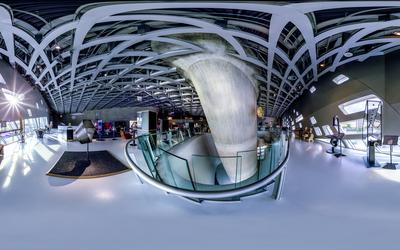
Images come to life in the new Image Dance experience area. From the animated film station to impressive works of art such as the Secret Life carousel or String Theory, visitors can discover how movement, stories and entire films are created from individual images - analogue, experimental and full of wonder.
Movement originates in the mind.
How do many individual images become a flowing film? The new BILDERTANZ exhibition area allows visitors to experience precisely this fascinating interplay of perception, time and movement. What we take for granted today - cinema, series, animations - is based on a simple but effective illusion: images follow one another so quickly that our eyes no longer perceive them individually. Movement is created.
At BILDERTANZ , visitors experience these basic principles of the moving image with their own bodies, their own eyes and their own curiosity. Art, science and experimentation intertwine seamlessly.
A central theme is so-called afterimages - impressions that remain on the retina for a short time. They are crucial for us to merge individual images into one movement. The String Theory artwork makes this phenomenon impressively visible.
String Theory.
A rapidly rotating nylon strip creates fascinating three-dimensional shapes. The movements sometimes appear harmonious like a vibrating violin string, sometimes restless and chaotic.
As the strip rotates faster than our eyes can perceive individual images, the impressions are briefly retained on the retina and merge into a spatial volume.
Physicists are investigating similar patterns of movement in what is known as string theory: they assume that matter and energy consist of tiny vibrating "strings". However, these are so small that - unlike in this light installation - they cannot yet be observed directly.
Join in, try it out, understand it.
The area is deliberately designed with little digitalisation. Instead of screens, the focus is on mechanical devices, light, movement and personal activity. This creates a direct understanding of how moving images work.
At the animated film station, children, young people and adults create their own short animated sequences. They change motifs frame by frame and then set them in motion. The learning effect is immediate: even the smallest changes are enough to bring images to life - a central insight of film history.
Carousel with flying birds.
A rotating drum contains ten models of a bird, each showing a snapshot of a flapping wing. If you look at the drum from above, all the figures are visible at the same time. However, if you look through the side slits, only one bird is revealed at a time for a brief moment.
Due to the uniform rotation of the drum, the individual flight phases follow each other so quickly that our eyes no longer perceive them separately. Instead of individual still images, the impression is of a flowing movement: The bird appears to be flying.
At least 10 to 14 images per second are required for our brain to put together a movement from individual images. For a smooth film experience - like in the cinema - at least 24 frames per second are shown today.
The carousel is a direct relative of the wonder drum, also known as the zoetrope - one of the most important precursors of the cinema machine. What seems like a playful experiment today was a technical sensation in the 19th century. For the first time, such devices made it clear that movement is not a property of the images themselves, but is created through the interplay of eye, time and sequence.
Secret Life - by Gregory Barsamian.
The Secret Life artwork by Gregory Barsamian is an absolute highlight. The non-digital zoetrope carousel consists of 16 rotating rods with handmade sculptures. A strobe light flashes with each rotation and illuminates the objects for fractions of a second.
The result: a surreal 3D film lasting around ten seconds that is created entirely in the mind of the viewer. Images develop from a malleable mass - from the brain to the rose, which disintegrates and re-emerges. The scenery appears dreamlike and invites interpretation between the imagination and the subconscious.
Barsamian's discovery of the vertical narrative style is particularly fascinating: The figures are arranged helically, so that the story is told not only in a circle, but also vertically - a unique extension of the classic zoetrope principle.
GREGORY BARSAMIAN. The artist studied philosophy. He is interested in Karl Jung's dream analysis as well as Nietzsche's belief that in a world without absolute truth, artists are the ones who can invent their own world. You can find even more art exhibits here 👉 Art exhibits